
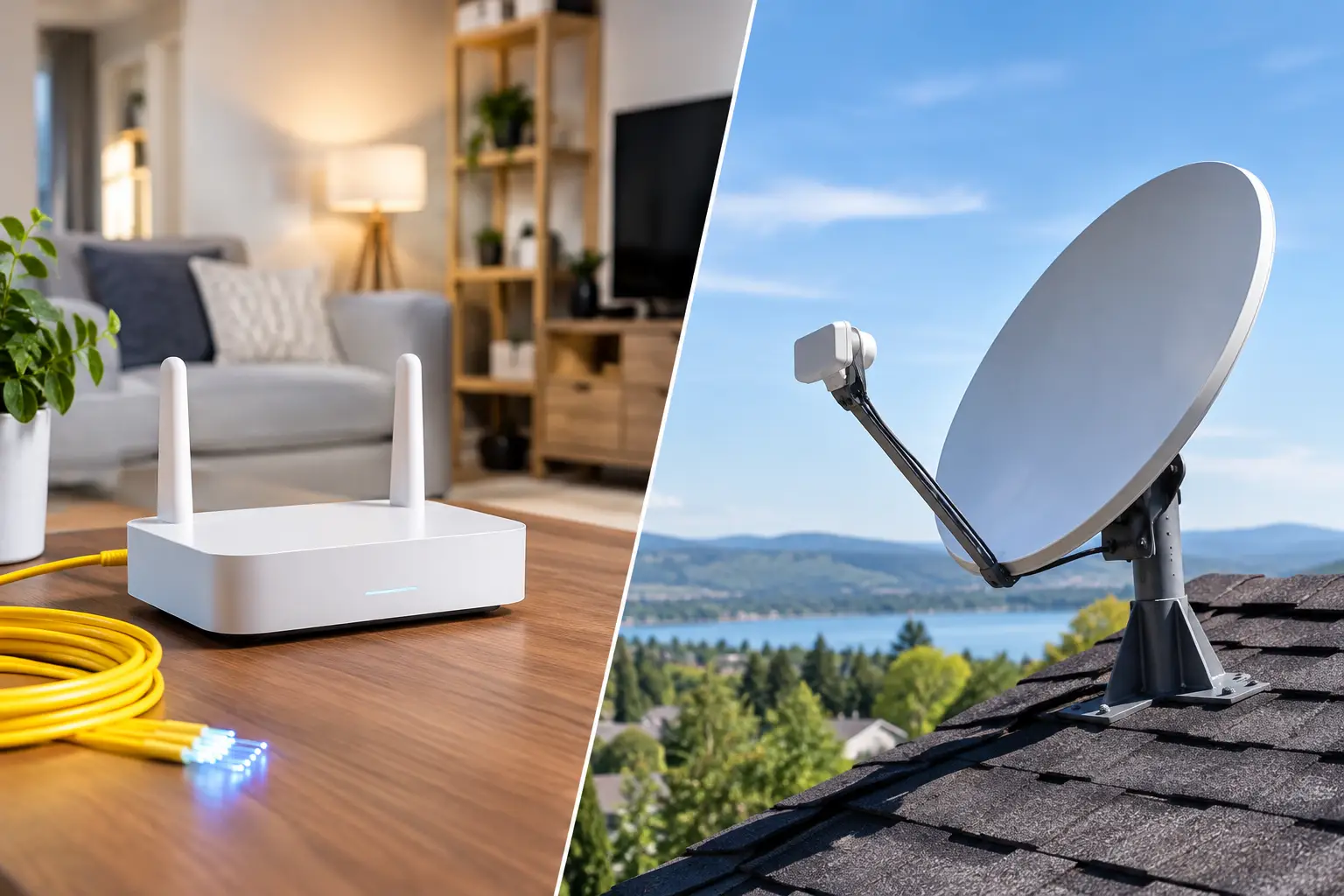
If both are available at your address, fiber vs satellite is usually an easy decision: choose fiber. Fiber is faster, has much lower delay, and handles a busy household far better. Satellite still has an important role, though. For rural homes, cabins, farms, and job sites beyond the reach of wired networks, it can provide a practical connection where the alternatives are limited or nonexistent.
The right choice depends less on a plan’s advertised top speed and more on what your household does online, what is actually available, and how consistent you need the connection to be.
Fiber vs Satellite at a Glance
Fiber internet sends data through thin strands of glass using pulses of light. It requires a physical fiber line to reach your home or building. That infrastructure is expensive to install, which is why fiber is common in many cities and suburbs but remains unavailable in plenty of rural areas.
Satellite internet sends data between your dish, a satellite in space, and a ground station connected to the broader internet. Your home does not need a cable line from the street, but it does need a clear view of the sky and equipment mounted outdoors.
| Feature | Fiber internet | Satellite internet | | — | — | — | | Availability | Limited to areas with fiber infrastructure | Available in many remote areas with a clear sky view | | Typical speeds | Often 300 Mbps to multi-gig speeds | Varies by satellite system, location, and network demand | | Upload speeds | Often equal to download speeds | Usually lower than download speeds | | Latency | Very low | Higher, especially with older geostationary systems | | Weather sensitivity | Low, though local outages can occur | Can be affected by severe weather and obstructions | | Best fit | Homes and businesses with demanding daily use | Locations without a practical wired option |
Why Fiber Usually Delivers a Better Everyday Experience
Fiber’s biggest advantage is consistency. A 500 Mbps fiber plan can support several 4K streams, video meetings, online gaming, cloud backups, security cameras, and everyday browsing at the same time without making everyone compete for a small pool of bandwidth.
Upload speed matters more than many people realize. Download speed affects how quickly you stream, browse, and receive files. Upload speed affects video calls, sending large files, backing up phones and computers, posting content, and remote access to cameras or work systems. Fiber often provides symmetrical service, meaning upload and download speeds are similar. That is especially useful for people who work from home or run a small business from their property.
Fiber also has low latency. Latency is the brief delay between an action and the network’s response. You notice high latency when a video call has an awkward pause, a game responds late to a button press, or a remote desktop connection feels sluggish. Fiber latency is commonly low enough that it fades into the background.
For a typical household, 100 Mbps is a practical starting point if usage is modest. Active families with several people streaming, gaming, attending video calls, and using connected devices will generally be better served by 300 to 500 Mbps. A gigabit plan or faster can make sense for heavy-use homes, frequent large uploads, serious gamers, home-based businesses, or households that simply want more room for many simultaneous users.
That does not mean every home needs the fastest fiber plan available. A couple who mainly streams and browses may see little real-world benefit from paying for multi-gig service. But fiber gives you room to grow without the performance limits that often come with satellite.
Satellite Has Changed, but It Still Has Trade-Offs
Satellite internet is not one single technology. Older geostationary satellite services use satellites positioned far above Earth. Because data has to travel that long distance into space and back, latency can be very high. Basic browsing and email can work fine, but real-time activities such as gaming, live video calls, virtual private network connections, and remote work may be frustrating.
Newer low Earth orbit satellite systems operate much closer to the ground. They can provide substantially lower latency and better performance for video meetings, streaming, and general household use. For many rural customers, this has made satellite a much more realistic primary internet option than it was a few years ago.
Even newer satellite service has limitations. Performance can vary by location, time of day, local demand, and whether your dish has a truly open view of the sky. Dense trees, nearby buildings, rooflines, and even seasonal leaf growth can interrupt the signal. A property that looks open from the driveway may not have a suitable mounting location once the installer considers the sky path.
Weather is another consideration. Heavy rain, snow accumulation on equipment, and severe storms can weaken or temporarily interrupt satellite service. Fiber can also go down during storms, particularly if power equipment or local network infrastructure is damaged, but the connection itself is generally less affected by ordinary weather.
Data Policies and Peak-Time Performance Matter
When comparing plans, do not stop at the advertised speed. Read the service details for data policies, network management, and any priority limits.
Some satellite plans may offer a certain amount of priority data each month. After that amount is used, your service may continue but receive lower priority when the network is busy. In practical terms, the connection may feel slower during evening hours or in areas where many customers share the same satellite capacity.
Fiber plans are more likely to offer unlimited data, although policies vary. They also tend to hold up better during peak evening use because the underlying network has greater capacity and does not depend on a shared wireless path to space.
For households that regularly stream live TV, use several 4K televisions, download large games, or back up lots of photos and video, data terms deserve close attention. A plan that works well for web browsing may feel restrictive once the whole family is using it normally.
Installation and Equipment Are Different
Fiber installation typically involves running a fiber line to the home, placing a small optical network terminal inside or outside, and connecting your router. In some cases, installation is straightforward. In others, especially at new construction or homes set far back from the road, extending the line can take time or involve additional costs.
Satellite requires a dish, mounting hardware, a clear view of the sky, and a cable route into the home. Renters should get written permission before equipment is attached to a roof, wall, balcony, or pole. Homeowners should also think about where the dish can be safely accessed if it needs adjustment or snow removal.
Neither service automatically fixes poor Wi-Fi inside the house. You can have fast fiber and still deal with buffering in a back bedroom if the router is poorly placed. Likewise, satellite performance will not improve simply because you bought an expensive router. Make sure the internet connection is suitable first, then address indoor coverage with proper router placement, a mesh system, or wired connections where practical.
Which One Makes Sense for Your Situation?
Choose fiber when it is available at a reasonable price and your household depends on the internet daily. It is the stronger option for remote workers, students, gamers, streamers, smart-home users, and small businesses that need dependable uploads and responsive connections. It is also the better long-term choice for a home where internet needs are likely to increase.
Choose satellite when you live or work where fiber, cable, and reliable fixed wireless are not available. A modern low Earth orbit option can be a major improvement over older rural connections, especially for households that need usable video calling and streaming. Just set expectations appropriately: it may not be as steady as a good wired connection, and local conditions matter.
If your only wired option is an older low-speed plan below 100 Mbps, satellite may deserve a closer look. That comparison is less clear-cut than fiber versus satellite. Check real-world availability, plan terms, installation requirements, and whether the satellite dish will have an unobstructed view before deciding.
For most people, the practical rule is simple: get fiber if you can, and consider satellite when geography leaves you without a solid wired choice. The best internet service is not the one with the most impressive marketing claim. It is the one that reliably supports the way your household actually lives, works, streams, and stays connected.