
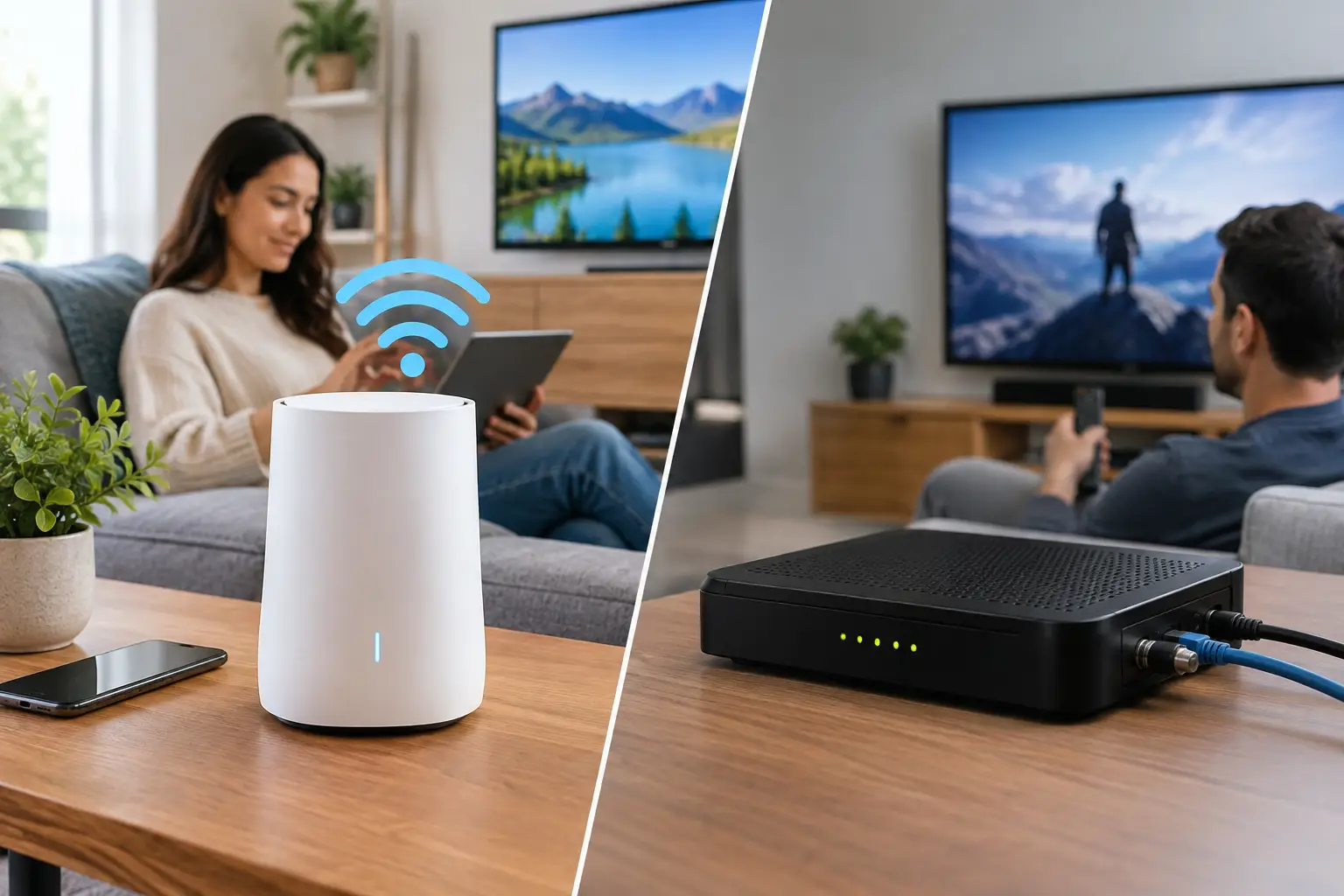
A new cable line can mean installation appointments, equipment fees, and a familiar monthly bill. A 5G home internet plan may promise a simpler setup: plug in a gateway, place it near a window, and get online. But 5G home internet vs cable is not simply a choice between old and new technology. The better option depends heavily on your address, how many people use the connection, and what they do online.
Cable is still the safer all-around choice for many busy households because its performance is generally more consistent. 5G home internet can be an excellent alternative where the local cellular network is strong, especially for renters and people who want a straightforward, contract-free setup. The key is knowing where each service has limits before you switch.
5G Home Internet vs Cable at a Glance
Cable internet reaches your home through the same coaxial wiring often used for television service. It is a wired connection from the neighborhood network to your modem, although your phones, TVs, and laptops still use Wi-Fi inside the home.
5G home internet is fixed wireless service. A provider sends internet service from a nearby cellular tower to a 5G gateway in your home. That gateway acts as both the modem and Wi-Fi router. Unlike mobile phone service, it is designed to stay at one approved address.
The practical difference is consistency. Cable performance can vary during busy evening hours, but it is usually less affected by weather, building materials, and the exact location of a device. 5G performance can be very good, yet it depends more on local tower capacity, signal strength, and congestion on the cellular network.
Speed: Cable Usually Has the Higher Ceiling
For a typical household, 100 Mbps is the minimum practical starting point. That is enough for several everyday tasks, but homes with multiple streamers, remote workers, gamers, and connected devices are usually better served by 300 to 500 Mbps. Heavy-use households may benefit from 1 Gig service or more.
Cable plans commonly offer those middle and upper speed ranges. Download speeds of 300 Mbps, 500 Mbps, and 1 Gig are widely available in many cable markets. That gives cable an advantage for households that regularly download large games, back up files to the cloud, or have several people streaming 4K video at once.
5G home internet speeds are less predictable. One home may see 300 Mbps or more, while another a few blocks away may see much less because of tower placement, network traffic, terrain, or walls and windows. A strong 5G connection can easily support streaming, browsing, video calls, and normal work-from-home use. It may be less suitable when a household needs consistently high speeds at all hours.
Upload speed deserves attention, too. Many cable plans provide much faster downloads than uploads. That is fine for most streaming, but it can be limiting for frequent cloud backups, sharing large work files, livestreaming, or households with several people on video calls. 5G upload speeds also vary widely, so check real-world results instead of relying only on a plan’s advertised maximum speed.
Reliability Is More Than a Speed Test
A speed test taken at 10 a.m. does not tell you how an internet connection will perform during a crowded 8 p.m. streaming window. Cable and 5G can both slow down when many nearby customers are online, but 5G is often more sensitive to local demand because it shares cellular capacity with mobile users.
Cable may be the better fit if you depend on your connection for remote work, online classes, security cameras, or competitive gaming and cannot easily tolerate occasional swings in performance. It is not immune to outages, and neighborhood congestion is real, but a wired connection is usually more stable from day to day.
5G home internet is worth serious consideration if cable service in your area has been unreliable, the available cable plans are overpriced, or you need a quick option after moving. It can also be useful as a backup connection for a home office or small business, provided the plan’s terms allow it and local signal quality is strong.
Latency matters for gaming and video calls
Latency is the small delay between sending data and getting a response. It matters more for live activities than for download speed. High latency can make an online game feel sluggish, cause slight delays in video calls, or make remote desktop work less responsive.
Cable usually delivers lower and more consistent latency than 5G home internet. Casual gamers and most video-call users may not notice a major difference on a good 5G connection. Competitive gamers, frequent livestreamers, and people who use sensitive work applications are more likely to prefer cable.
Data Limits and Plan Terms Can Change the Value
Do not assume every plan includes unlimited high-speed data. Some cable plans include a monthly data allowance, while others do not. Some 5G home internet plans are marketed as unlimited but may manage network traffic during periods of heavy congestion. The details vary by plan and location.
This matters for households that stream most of their TV, download games, use cloud storage, or have several cameras uploading footage. A family can use a surprising amount of data without doing anything unusual. Read the plan terms for data caps, overage charges, deprioritization language, equipment fees, taxes, and any price changes after a promotional period.
Price comparisons should include more than the advertised monthly rate. Cable may have separate modem or gateway fees unless you use approved equipment you already own. With 5G home internet, the gateway is commonly included, but you may have fewer choices if you want to upgrade your Wi-Fi setup later.
Your Home Wi-Fi Can Be the Real Bottleneck
Neither service can perform well if the Wi-Fi inside your home is weak. A 500 Mbps cable plan will not fix a router stuck in a cabinet at one end of a large house. Likewise, a 5G gateway placed wherever the signal is strongest may not be the ideal location for Wi-Fi coverage.
With 5G home internet, placement is especially important. The gateway may work best near a specific window or on an upper floor, but that spot could leave bedrooms, a basement office, or a detached workspace with poor Wi-Fi. Before committing, test coverage where people actually use the internet. A mesh Wi-Fi system can help extend coverage, though compatibility with a provider-supplied gateway should be considered.
Cable offers more flexibility in some homes because a technician may be able to activate a coax outlet closer to the center of the house. You can also often use your own compatible modem and router, which gives you more control over Wi-Fi features, parental controls, Ethernet ports, and future upgrades.
Who Should Choose Cable?
Cable is usually the stronger choice for active families, shared homes, and small businesses that need predictable performance. It is particularly well suited to homes with 300 to 500 Mbps needs, regular 4K streaming, multiple video calls, large downloads, wired gaming devices, and lots of simultaneous users.
It also makes sense when you want the option to use a more advanced router, add a mesh system, or connect desktop computers and game consoles by Ethernet. If fiber is available at your address, compare it too, since fiber can offer even better upload performance and consistency than cable.
Who Should Choose 5G Home Internet?
5G home internet makes the most sense for renters, people who want minimal installation, and households with moderate internet needs in an area with verified strong 5G coverage. It can be a practical choice for one or two people who stream, work from home occasionally, browse, make video calls, and do not need rock-steady low latency.
It is also worth considering if the monthly price is clearly lower than cable after fees, or if you need service quickly after a move. Just avoid treating coverage maps as a guarantee. Ask whether there is a trial period or return window, then use it to test the service at different times of day.
A good internet choice is the one that stays usable when the house is busy, not just the one that posts the best speed-test number. Check the plan terms, test Wi-Fi in the rooms that matter, and choose the connection that matches how your household actually lives online.